AI for real work · 1 of 5 · Discover
Where AI can add value to your business and how to estimate its cost
When a business receives an enquiry, more than words begin to move. Someone interprets the request, finds information, compares possibilities and prepares a reply. By the end of that process, knowledge that was scattered across different places has become something another person can use.
This is a useful starting point for thinking about artificial intelligence: the work of turning available resources into results we want to achieve. In Techne, we follow the same idea through fire and simple machines. Here, the material we work with will often be documents, images, conversations and decisions.
AI expands our ability to work with those resources. To use it well, we need to understand the change we want to make and what currently makes it difficult.
An enquiry that puts the whole business to work
Imagine a small spare-parts distributor. A customer needs a replacement and sends an incomplete description. The salesperson identifies the model, checks a technical document, looks up the price and asks about availability. Then they write the reply.
The enquiry seems simple. Answering it required bringing together knowledge from different places and connecting it to a particular need. When similar enquiries arrive throughout the day, that effort occupies a considerable part of the working week.
What would we like to achieve? We could aim to prepare correct replies in less time, retaining review by someone who knows the products. The purpose now has an observable form: how long a usable reply takes and which conditions it must satisfy.
This distributor is a hypothetical example used throughout the series. Its figures explain how to reason about a project; results in a real business will need to be measured.
Where could AI contribute?
We can break down the work. It involves interpreting the request, finding information, relating it to the case, calculating and communicating. Each part calls for a different capability.
A language model can help interpret a description and draft a reply. A search tool can locate the relevant technical documents. Prices and availability need to come from authorised business sources; arithmetic can be handled by calculation functions and rules.
Combined, these capabilities could present a draft alongside its references. The salesperson would check compatibility, price and terms before sending it. If the part model is missing, the next useful result would be a question that helps complete the request.
An opportunity is taking shape. We can explain which work would receive assistance, where the information would come from and which decision a person would still make.
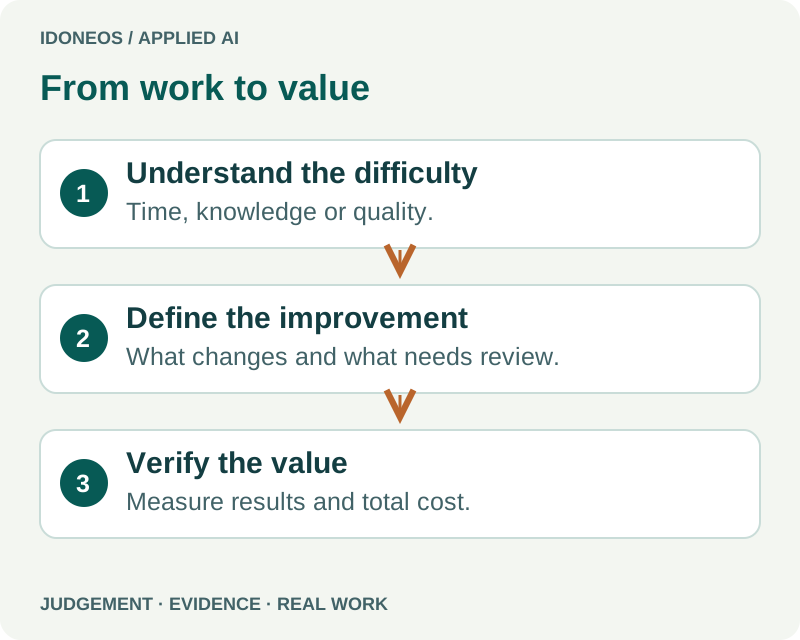
From available time to value produced
Suppose, just to work through the calculation, that the business handles 40 enquiries a week, spending 18 minutes on each. If a test showed that it could resolve them in 8 minutes, including review, the difference would be 10 minutes per enquiry.
40 enquiries × 10 minutes = 400 minutes a week: 6 hours and 40 minutes potentially available for other work.
The calculation shows available capacity. Its value depends on how that capacity is used: handling requests that currently go unanswered, following up with customers or reducing overtime. An economic estimate needs to explain which outcome is expected and how it would be verified.
Quality may matter too. If incomplete replies generate repeated enquiries, reducing those repetitions has value even when the first reply takes the same time. We therefore need to follow the work through to resolving the customer’s need.
What it costs to build that capability
Achieving the improvement will require preparing sources, connecting tools, designing review and helping people use the whole process. Later, prices and documents must remain current, problems need attention and changes need evaluation.
Costs include an initial effort and recurring work. Technical services sit alongside the time people spend preparing, reviewing and maintaining the process. A first estimate can use a range, explaining how enquiry volume, document quality and required connections affect it.
Looking this closely may also reveal a more direct improvement. If an outdated price list causes most of the delay, putting it in order can already produce value and prepare a future AI application.
An opportunity we can test
The idea now has a purpose, a defined task, identified sources and a way to recognise the result. We still need to learn whether the assistance reaches the required quality and how much effort it demands. Those uncertainties guide the next step.
The AWS guidance on AI adoption also begins by connecting use cases to business objectives and resources. For our distributor, that connection fits into a sentence: prepare reviewable replies to spare-parts enquiries using current information, so the team can provide better service with its available time.
An opportunity expressed this way can be compared with others to decide where the first effort belongs.