AI for real work · 5 of 5 · Integrate
From experiment to everyday work: integrating an AI solution
A tool takes on a different importance when we can count on it whenever it is needed. At our distributor, a reply prepared during a test is a useful beginning. For the improvement to reach customers, the team needs that capability during its working day, with current information and a way to handle problems.
Integration makes the capability available within the work we want to improve. It brings together technical development, process decisions and people’s learning.
The proof of concept and pilot provide a foundation: we know what was evaluated, what happened and which conditions were required. That evidence can guide the first version for routine use.
Give the capability a recognisable place in the work
Consider the salesperson receiving an enquiry. They need to open it, identify available information and request assistance. With the draft, they should be able to see references, recognise missing details and review what will be sent to the customer.
The interface needs to support that sequence. At each point it should show what can be done and what that action achieves. If the part has not been identified, it should help complete that information. When a reply is ready, review becomes the next step.
This is development too. Drafting capability needs a clear way to use it. Designing both together can reduce searches, copying and uncertainty that would otherwise consume some of the time gained.
Connect information and preserve judgement
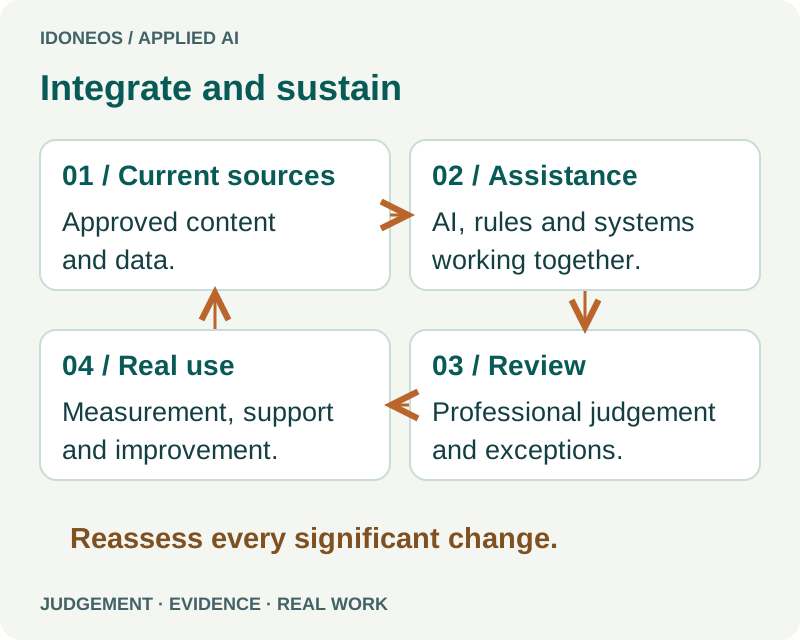
Once the solution is in use, sources will change. New products arrive, prices change and some parts become unavailable. The solution needs to consult authorised records and show where relevant information came from.
In our distributor’s process, the tool prepares a draft and a person confirms the terms before sending. That approval must apply to the version reviewed. If the price or content changes, it needs checking again.
Interruptions belong in the design. A failed stock lookup should show availability as pending. If sending is interrupted, the system needs to preserve its state and prevent a retry from duplicating the message.
These decisions keep the meaning of the work understandable from one stage to the next.
Learn through cases from the work itself
Training is more useful when people can resolve enquiries like those they receive each day. Practise a straightforward reply, an incomplete request and a case that needs someone with more experience.
People need to understand how to check sources, the assistance’s limits and how to continue when the service is unavailable. Their experience will also reveal difficulties that did not appear in the test.
Make time for that learning and listen to what happens during use. A reference may be hard to find, or a necessary detail may appear too late. Correcting those details can matter as much to daily usefulness as improving the draft.
Know who can act when something changes
Each part of the process needs clear responsibility. Someone in the business decides which enquiries are covered and under which conditions; someone maintains the catalogue; someone handles technical operation. In a small team, one person may hold several roles.
What matters is knowing who can resolve each problem. Conflicting documents need product knowledge. An access failure needs technical attention. A change in commercial terms needs a business decision.
The NIST AI Risk Management Framework brings design, use and evaluation into the same perspective. In practice, maintaining a solution means reviewing sources, permissions and the conditions that support its results.
Verify that the improvement continues
After launch, return to the initial questions. How long does a reviewed reply now take? Which errors occur? How much work remains pending? How is any released time being used?
Observing use shows whether the tool has become part of the activity. Measuring the whole process helps judge its value. Service costs, maintenance and review time also belong in that assessment.
When a source, an instruction or an important component changes, repeat evaluation with known cases and add examples of new difficulties. This helps determine whether the current version preserves the conditions that justified using it.
The ability to keep building
The process began with a purpose: answer customer enquiries more effectively. Pursuing it required understanding the work, choosing where to intervene, preparing resources, testing an idea and giving it continuity.
That effort leaves something beyond the tool. The business knows its sources better, has made some of its judgement explicit and has a way to study further improvements.
As with the machines examined in Techne, value arises when technical capability serves a desired transformation. AI expands what we can do; people’s knowledge, decisions and work turn that possibility into something available for use.