AI for real work · 3 of 5 · Prepare
Is your business ready for AI? What to review before you start
A ramp can allow someone to raise a load they could not lift with their arms. First, however, they need materials, suitable ground and an understanding of where the structure will rest. What a tool makes possible also depends on the conditions that allow it to be used.
After choosing a first project, we need to identify those conditions. Our imaginary distributor wants to prepare draft replies about one family of spare parts. Preparation means bringing together what is needed to study that task and judge its results.
The question becomes concrete: what must be available for a person to use and check those drafts?
Having information and being able to use it
In Techne, we connect a resource’s value to its availability for a purpose. A catalogue stored in a folder may contain valuable information and remain difficult to use if nobody knows which version is current.
Imagine finding two technical documents with the same product name and different specifications. Before asking AI for a reply, someone must establish which document applies and which variants exist. That is business knowledge the tool needs in a usable form.
For each source, it helps to know its origin, validity and who can resolve a question. Prices require an authorised source. Availability requires a record that reflects stock and a clear understanding of how quickly it is updated.
Preparing information means preserving these relationships. It also means identifying what each user may access and which customer information the task requires.
Make experienced judgement visible
An experienced salesperson may recognise that two parts look similar but perform different functions. A detail in the description may tell them what to ask before replying.
If that judgement surfaces only when an incorrect result is reviewed, an important part of the problem will remain hidden during development. Gather resolved enquiries and explain why each reply was appropriate, which detail mattered and what would have required someone else’s input.
This produces examples for developing and evaluating the assistance. It also helps define an acceptable reply: identify the part, use the correct source, flag missing information and preserve authorised commercial terms.
People who know the work are part of the project. They need time to explain, review and test.
Prepare the whole process
The draft will enter a working process. We need to know who starts the enquiry, what information they provide, where they review the result and what they do when something is missing.
In our example, a request without a part model should lead to a question for the customer. Conflicting documents need input from the catalogue owner. These routes let work continue when there is not yet enough information for a reply.
Connections also need checking. If prices live in another system, we need authorised access and a way to recognise a failed lookup. That lets us distinguish an absence of stock from an interruption in the service reporting stock.
Give the first test owners and boundaries
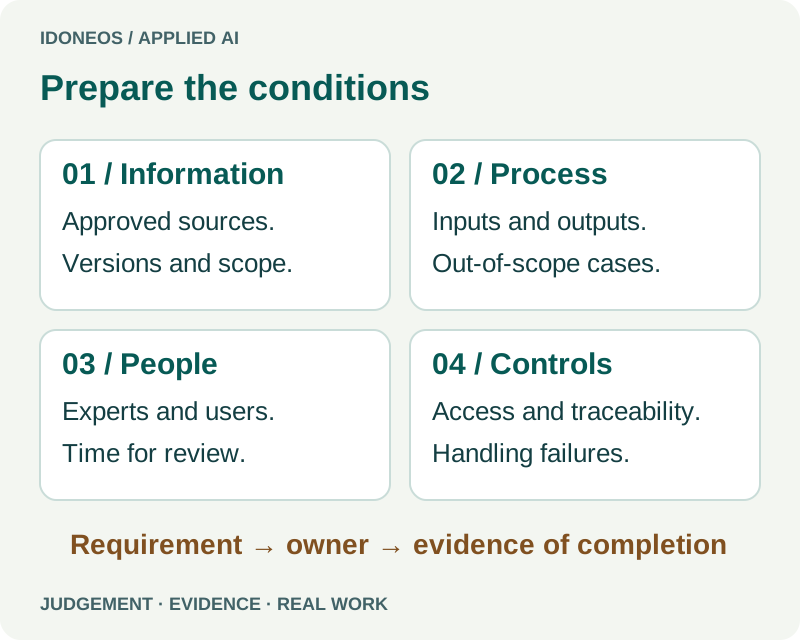
The diagram’s four conditions support each other. Documents need an owner; review needs criteria; people need time; permissions need to allow the agreed work.
A first test can use historical enquiries prepared for that purpose and an identified catalogue version. The team must establish which data may be processed and under what conditions. Sending messages to customers can remain outside that initial scope.
Trust grows through decisions we can verify. The NIST AI Risk Management Framework brings these considerations into system design, use and evaluation. In a small business they become practical questions: who may see what, who reviews and who can help when something fails?
Turn a gap into work someone can complete
“The data needs organising” is too broad to guide action. A more useful statement is that the catalogue owner will identify current documents for the chosen product family and resolve contradictions before evaluation begins.
The task now has a recognisable result, an owner and a time. We can distinguish it from questions to be studied within the test, such as how long reviewing a draft takes.
By the end of preparation, we should be able to assemble sources, work through examples, explain how results will be judged and identify outstanding work. With those supports in place, the opportunity has conditions for producing evidence.