AI for real work · 2 of 5 · Choose
Which AI project should you start with? Impact, complexity and risk
A lever moves a load by relating force, distance and a point of support. Making good use of it means understanding where each belongs. AI opportunities involve a similar question: the available capability becomes useful when we find where and how to apply it.
In the previous article, we imagined a distributor that wants to answer spare-parts enquiries more effectively. Several ideas follow: prepare drafts, organise the catalogue, recommend substitutes or send quotations automatically. They concern the same business, but each demands different work and commits different decisions.
Choosing the first project means understanding those differences and finding a beginning the business can sustain.
What would change if it worked?
Impact is the contribution an improvement would make to the result we want. Estimating it means explaining how that contribution would arise.
For the distributor, a draft could reduce the time spent gathering information and writing. To judge its importance, we need to observe how many enquiries arrive, how much of the working day they occupy and what the released time could make possible.
Recommending a substitute could have another effect: fulfilling orders currently lost because the original part is unavailable. That depends on suitable alternatives existing and on our ability to identify them reliably enough.
Explaining impact makes these conditions visible. It helps distinguish a reasonable expectation from a possibility that still needs investigation.
Complexity lies in the relationships
An idea can be described in a few words and require substantial work. “Answer an enquiry” may involve conflicting documents, different commercial names, access permissions and decisions understood by only one experienced person.
Complexity concerns the difficulty of bringing together the conditions needed for the solution to work. Information, connections to other systems, case variety and the effort of checking results all contribute.
Compare two scopes. The first prepares a draft for one product family, shows its sources and passes it to a salesperson. The second selects substitutes across the catalogue, sets commercial terms and sends the offer to the customer. The second involves many more relationships to understand and verify.
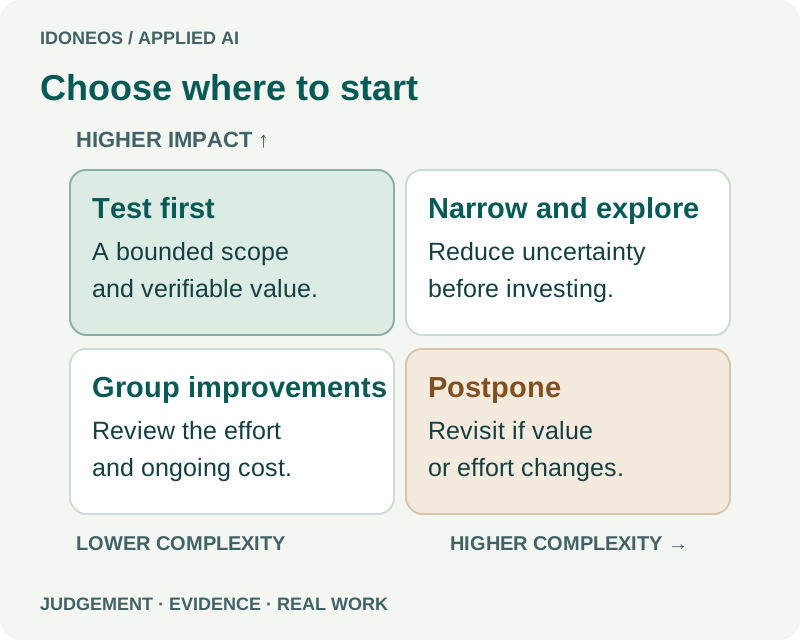
Mapping ideas by impact and complexity makes that difference visible. The diagram supports a discussion; every position needs reasons that people in the business can examine.
The consequences of an error matter too
Two projects may sit near each other on the map and require different controls. An error in a draft reviewed by a salesperson can be caught before reaching a customer. An error in an automatically sent quotation can commit an incorrect price, delivery date or compatibility claim.
We therefore need to ask what happens if the solution gets something wrong, who could notice and how it would be corrected. The review needed belongs in the project’s effort estimate.
Starting with drafts allows our distributor to observe performance within a process that retains commercial approval. The scope should specify what the tool may prepare and what the person must confirm. That division makes a first experience possible with more limited consequences.
Choose a question worth answering
A first project offers both a possible improvement and learning. If we do not yet know whether the documents allow parts to be identified correctly, testing that could guide many later decisions.
A useful first question is whether the available documentation can support replies that take less effort for the salesperson to review. Studying one product family and a collection of previously resolved enquiries may provide a starting point.
That beginning remains connected to the purpose while reducing the unknowns addressed at once. Favourable results would justify studying other families and tasks. Difficulties would show more clearly where intervention is needed.
Give the project a point of support
The choice should record which work will be studied, who understands it, which resources will be available and what evidence we expect. Reasons for postponing other ideas are useful too: missing information, costly integration or value that remains uncertain.
For our distributor, the first priority could be reviewable drafts for one product family, without sending them to customers. The choice rests on frequent work, identifiable sources and a person able to judge the result.
We have found a place to apply the effort. Next, we need to check that it can support that effort: what information, people and conditions must be prepared before building the test?